Saturday, February 1, 2014

Montezuma's Revenge

Photo by Joel Gill 2014
The photo above, courtesy of Geology for Global Development, was taken at San Pablo La Laguna, a small town across the lake from where I'm living. This mural shows the local opposition to mining activities, an issue that was so beautifully documented by filmmakers Frauke Sandig and Eric Black in their film, Heart of Sky, Heart of Earth, which I saw last fall at the Margaret Mead Film Festival. It was a very powerful film about (among other things) the Canadian mining companies that are destroying the Mayan land and people who depend on it. Here's a quote from the film's website:

"It is quite possible our great corporations will succeed in finishing Nature off …
and expel the Indigenous from their lands. On the other hand, resistance is growing. 
Many young Maya say the world will not go under. It will start anew, 
but we all have to fight for it, here and now."

Yesterday, the U.S. State Department released its "final report" on the environmental impact of the Keystone XL pipeline, which the mainstream media say "paves the way" for Obama to approve it. It is no surprise that "the report was written by a deeply compromised contractor who was practically handpicked by TransCanada and the American Petroleum Institute." (Credo Action)

I briefly saw (perhaps in a preview for a documentary) the damage the Keystone XL pipeline has already done in Canada. It was horrific! This pipeline is one of the most evil ventures with the potential to hurt many people!


OK, now back to our regularly scheduled program. Below are some pics that I took before being laid up in bed for a few days with "Montezuma's Revenge." We must all suffer the wrath resulting from white imperialism at some point in our search for truth and happiness. (remember, click on the photos to get a larger view).


Tuesday, January 28, 2014

Living in Guatemala!

(The best way to see these pictures is to click on them for a larger view).

On my walk this afternoon.

OK, anyone reading this already knows that I've moved to Guatemala with my daughter for five months. She's attending a semester of high school at an international bilingual school. I will try to post here on a regular basis.

' '
Outside my bedroom door.

Monday, April 29, 2013

The Fabric of Egypt After Revolution


(The best way to view these pictures is to click on one and then watch them as a slide show).

Tahrir Square. The park is closed to traffic, and people are still
camped out to protest the government.
Folks have asked about my time in Egypt — a part of the world that continues to galvanize graphs on a regular basis. The Middle East has seemingly been colonized as a state of mind by the United States, with no separation between Syria, Bahrain, Yemen, Libya, Lebanon and Egypt — the fear of violence pervades all. If one country is at war, it must mean that surrounding countries are at risk of the same.

Commemorating the folks who died fighting the revolution.

Protests and violence and discontent have become the fabric that covers human flesh, and all Egyptian culture, like wool washed in hot water and dried, shrinks to a tight fist — no traveling through a wide weave, now a mere representation of what is. 

Tahrir Square.
How can I explain that threads of language are simply pieces of an entire fabric, they are hanging chads that need mending? Meanwhile, children in Egypt go to school; people work there, shop, cook, pray, laugh, sing, play, walk, travel, plan, pursue careers, marry, die, make art and play music. They read the newspaper, listen to the radio and Internet, and receive tweets the same way we do. Egyptians are downloading news about their own country as you read this. One or a hundred are wounded; hundreds more show up for a funeral. Our media represents an entire country and beyond, 83 million people living in an area about two inches in diameter on the map.

I discovered on my initial flight to Cairo that I knew relatively little about Egypt, having based my knowledge upon the news analysis in the United States along with a bit of history. Turns out that few Egyptians voted in their newfound democracy, and are passionately against allowing their beautiful (yet crumbling) country to be defined by a fundamentalist right-wing power-hungry regime. 


They are angry that the revolution was “hijacked” by the Muslim Brotherhood, and are suffering the consequences of change within a collapsed economy, mostly due to a sharp decline in tourism. Of course, the dismal economic situation was part of what prompted the revolution in the first place.

My youngest daughter was scheduled to travel with a 5-person U.S. teen delegation to an International Peace Camp on the Red Sea this summer, about 5 hours drive southeast of Cairo. The theme of the camp is Human Rights, and will be attended by 15-yr-olds from 10 different countries, an incredible opportunity to halt fear in the minds of these teenagers in hopes of seeding friendship among young nation-building representatives. Unfortunately, fear continues to define that distant land for an older generation and determines its fate. A parent of one child, when I asked her if she was worried about a fuel shortage in Egypt, said: “My concern is nowhere near that there will be a shortage of aviation fuel. My concern is that the airport will be shut down because of civil unrest…It will be the mob that will shut it down either by barricading it, or there will be fighting nearby so that the airport will have to shut down.”

Camp at Tahrir Square.
Unfortunately, the trip was canceled (as a delegation it’s all or none). My daughter will miss out on the camp and the International group of teens will miss out on getting to know an American teenager who sows peace rather than the violence and war for which our democratic government is becoming known.


My fear is not that an angry mob of Arabs would shut down the airport, but a wayward American drone, in its blind search for terrorists, would find its way to the camp and snuff out the small but valiant effort to overcome fear of the Other.


Wednesday, February 20, 2013

Artists of the world, unite!


It was my last (and really only) day in Cairo after spending the previous two in bed sick, and I was still under the weather but determined to see a few sites before leaving. 

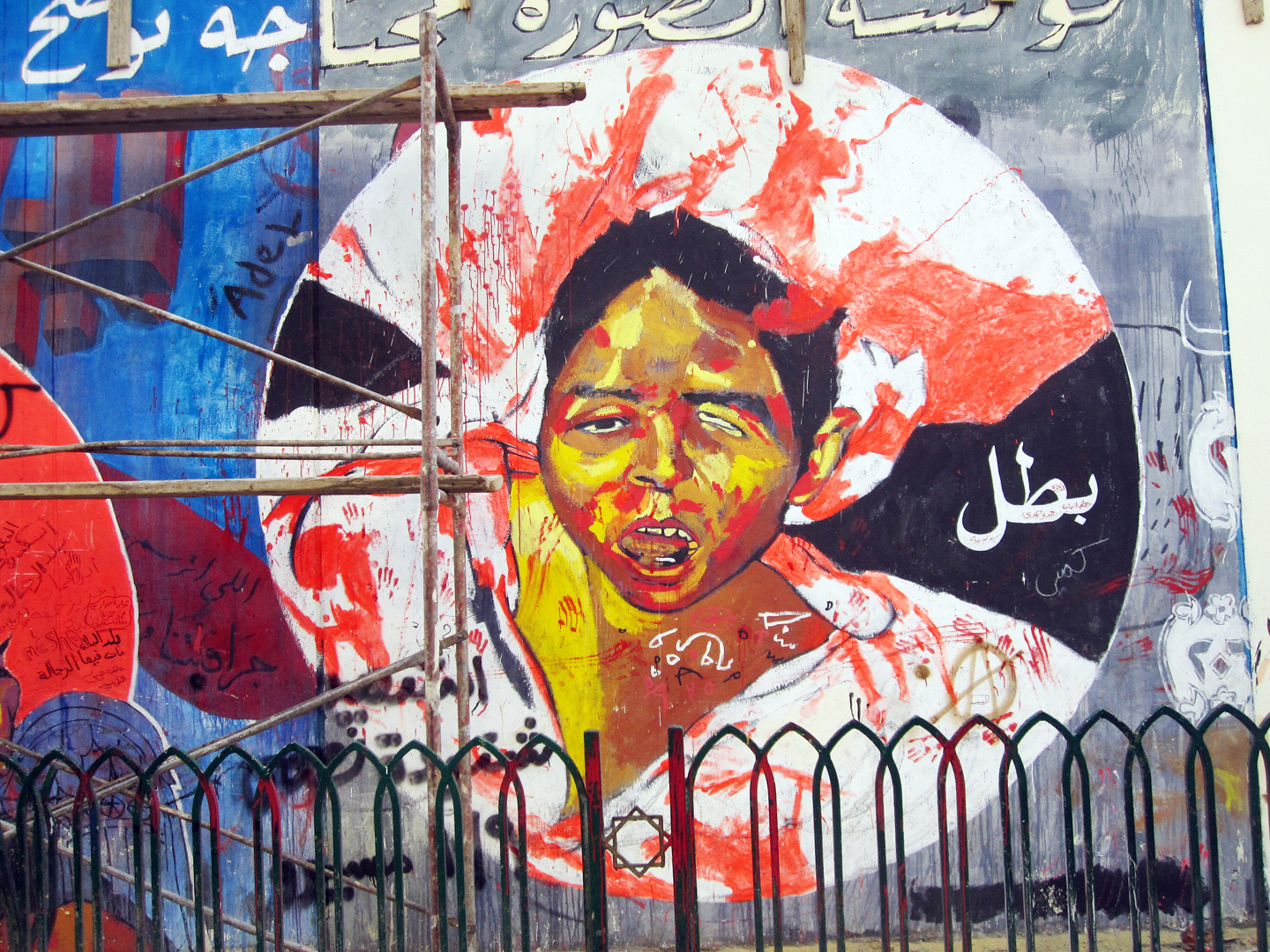
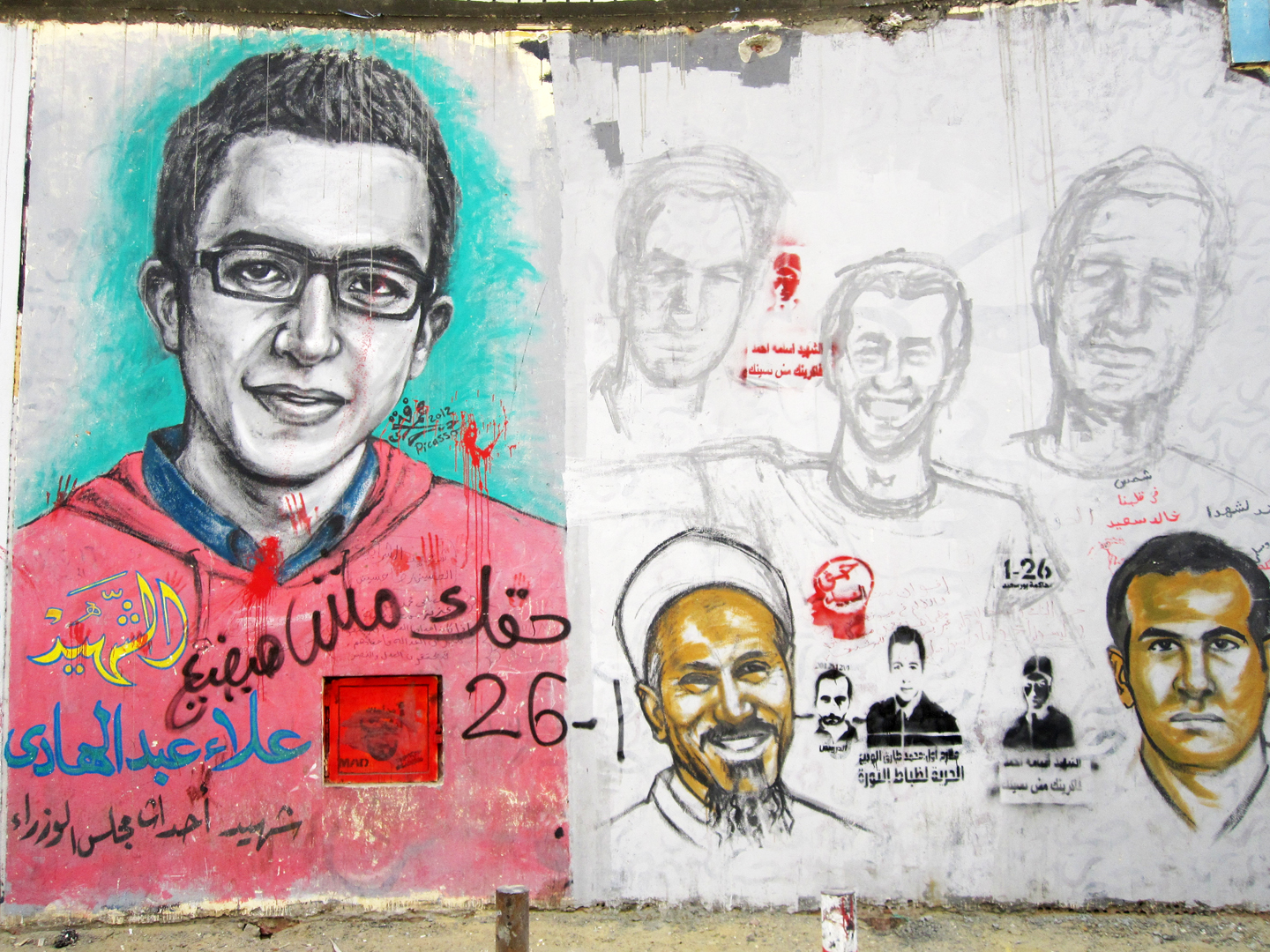
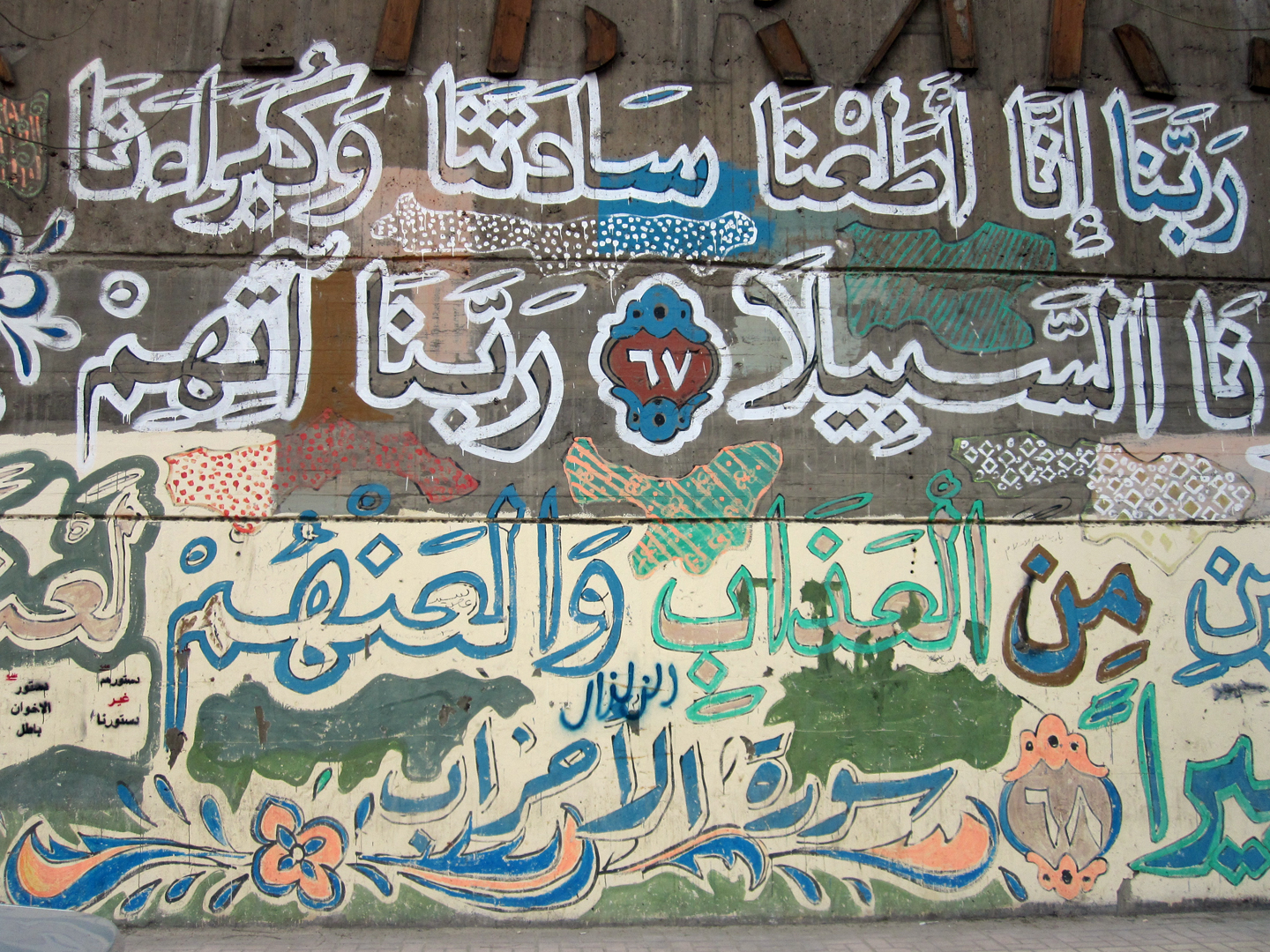
I had a brief encounter on Mohamed Mahmoud Street near Tahrir Square, with what became my most treasured experience.

What I found there on January 21 may not even exist anymore. It’s an ephemeral art, one that comes  and goes depending on the Egyptian government, which continues to subvert (paint over) the graffiti (or “erase history” as some have charged). 


Not to be deterred by the annihilation of their political and creative acts, local artists continue to take charge of their newly found “freedom” (relatively speaking).

My excitement upon finding this jewel, the “real” art of the 21st century — art that has a purpose outside the stifling confines of the New York (and other economically viable) markets, art that truly embraces a higher purpose other than mere decoration, intellectual compensation, and remuneration — has been dashed a bit. 


It seems the gold rush has begun, even the networks have gotten in the act. There are numerous folks in the blogosphere documenting the art of revolution and until I’ve written a more comprehensive analysis I’ll refer them to you below (after the pics). 

Probably the best way to view these is to click on a picture and then watch them as a slide show.


CAIRO STREET ART

Capturing the Art that Defined Egypt's Revolution
http://www.thetakeaway.org/2013/feb/07/revisiting-egypts-revolution-through-its-artists/

Revolutionary art mirrors Egypt’s changing pulse

Graffiti: the art of revolution in Egypt continues

Egypt: Art and the revolution

'Erasing history': Egyptians bristle after graffiti murals painted over

Egyptian graffiti artists target whitewashed walls and the president

Graffiti in Cairo and Tahrir Square

Graffiti in Egypt: New form of alternative media


Revolutionary Graffiti From Egypt

Graffiti in Egypt

Khaled Hafez: Art and Revolution in Egypt

Art in Egypt's Revolutionary Square

TAHRIR-LIBERATION SQUARE
http://www.tahrir-liberationsquare.com

Art & Revolution in Egypt: The Forgotten Writers Foundation