Tuesday, February 12, 2013

Better late than never -- Egypt time

(The best way to view these pictures is to click on one and then watch them as a slide show).

OK, I wasn't able to post in here while in Egypt, we didn't have internet! I learned that time is viewed differently there than in some western countries, everyone is a little bit late. So here are some thoughts and pics since then!

One of my initial responses upon working with a group of 27 people from 10 different countries (Brazil, China, Columbia, Denmark, Egypt, Finland, Germany, Norway, Sweden, U.S.) was how much they know about American TV, music, and films -- they use many of our colloquialisms and slang. The differences between us seemed small, as their language was so familiar even as their accents were not -- they could all be living in New York! 

There is a transparency that makes me feel at a disadvantage, as if they can know me but I can’t know them. They have a window through which to see me and my country. Of course, we know this is a very distorted view, but a view none-the-less. 

I like surprising people from other countries when they meet someone like me who is not what they see on television. Even more so, I like that I’ve never seen the shows they refer to, and sometimes have never heard of them! Can I actually be American in that case?

The globalization that is taking place is one that largely effects the wealthy and/or privileged, but will no doubt trickle down to the others. The Egyptians I’m working with (as well as participants from Columbia and China) have grown up going to private schools (French or American) and traveling abroad, living in stark contrast to the rest of their compatriots. The moral consolation seems to be the employment of those who would otherwise not have jobs. Is this the model that many right wing thinkers in our country have when they declare they don’t want to raise taxes on the wealthy? 


As our middle class erodes, does the United States become more like a “developing country” (or third-world, as they refer to themselves)? I want to ask our politicians, especially the republicans—would you rather that our country become more like India or Finland? 

Of course, I realize this is all so obvious, but experiencing it is so much more powerful than reading about it.

Did you know that in Finland they don’t use gender-based pronouns? They have only one word for he or she, him or her. Just a little piece of trivia I learned on this trip!


Stay tuned for more from Egypt! Soon...


Friday, January 4, 2013

Alexandria living


The article in Hyperallergic, “Artists On the Frontline of Egypt's Societal Revolution,” written by Jillian Steinhauer and published Dec. 26, 2012 (the day I left for Egypt), resonates with the project I’m doing here. Another very helpful one is “Artists and Islamists going head-to-head” by Rowan El Shimi, (Dec. 25). Rowan is a staff here on my IPP. This one is very comprehensive, it gives a bit of history and explanation for those uninitiated (which are most of us since we read primarily western media sources).

I spoke to an American poet who lives in Cairo, and she says she relies on Twitter for her news of Egypt, and follows a few key people. When I expressed my incredulity, she explained that in fact all media here is either run by government or is Islamist, so it is necessary. There is (rightly) much mistrust of both.

Mubarak and his military cronies allowed Egypt to disintegrate over the last 30 years. As one artist said, it’s a “failed state.” There is very little in the way of a solid infrastructure. Alexandria is chaotic and filthy, even by New York City standards, most apparently in the buildings that are crumbling inside and out. The streets, allies and airshafts are littered with garbage, sometimes piling high like sand dunes. 


Mind you, my view is limited to the downtown Alexandria area, but as this must be a central tourist spot, I thought it would be representative. It seems like the more control Mubarak had, the more apathetic people got and the fewer rules they followed. Traffic is many times more congested than New York, as there are no stoplights in a city of 5 million (imagine that)! Thus, crossing the street is a challenge. Day and night we hear a symphony of car horns, short and long beeps that overlay with one another near and far. But it becomes a kind of music, and mixed with the Muslim call to prayer (which is very beautiful), it blends in a Cage-like way.

Listening now to local artists talk about what they’re accomplishing in terms of change, and what they plan to do, is like watching the inside of a chrysalis evolve. It is slow, and at the same time an immense (and mostly hidden) transformation. While creative expression has always taken place, it was mostly a private affair. Censorship was a fact of life, and politics were far underground, if not nonexistent. The group of artists that formed Gudran (the organization we’re partnering with) has been trying to change this for 15 years, well before the revolution. But the revolution has given them a credibility (or permission) that took years to eak out, with their painstaking yet persistent work in local communities. They began by transforming a small fishing village, the residents of whom had been slated for relocation to the desert (fishermen?!). By introducing art to kids and murals on buildings, they eventually created a permanent artists’ space called El Max. I hope to visit there at some point.


The oppression that artists, musicians and filmmakers experienced prior to the revolution is practically incomprehensible to this westerner, but despite the unsure political future of Egypt, the artists and their supporters are determined to prevail in their newfound freedom.


Sunday, December 23, 2012

Winter in New York — Going on an adventure to Egypt!

Off to Egypt. I'll be there for a month and will try to write here regularly. It's an exciting time to be there, and hopefully will continue to be for some time to come!

For most of the visit I will be living in Alexandria. Alexandria is the second largest city in Egypt, population about 5 million people. I'll be working on an International People's Project (IPP) with: a staff of CISVers from Cairo; an international group of folks like myself; and a partnering group of cultural activists (Gudran). My job, among other things, will be to document this project. More will be revealed...

(from the staff) "In recent years, and more so after the uprisings, a large num­ber of cultural and artistic collectives have emerged. Spaces exhibiting audio and visual arts began to emerge in and around downtown Alexandria, mostly thanks to the growing micro-communities of artists, musicians, performers and cultural activists. In the past couple of years Alexandrians, and more broadly Egyp­tians, have witnessed a boom in street arts, be it graffiti, performance or music. Certain key associations are known to have had an ex­tremely significant impact on the development of the Alexandrian art scene in the past 10 to 12 years, and Gudran is definitely one of them.

"Our IPP is about spaces: physical and metaphorical spaces of expression and cultural dialogue. We will be working hands-on with Gudran on starting their new project: 'Bahna,' a new space for filmmaking and cinema in Alex­andria.

"Gudran has a history of turning run-down areas in Alexandria into art hubs. Past projects include transforming a warehouse into a gal­lery space. Their models are successful because they rely on volun­teers, artists and members of the community to manage them upon completion, ensuring sustainability and harmony between projects.

"Currently, they are working on restoring an 12-room massive apart­ment with the aim to turn it into a space for audio-visual arts. The apartment was once owned by Bahna Films, one of Egypt’s oldest production companies. Between 1932–1962, Bahna was the biggest cinema distributor in the Middle East with offices across the region. After restoration, rooms will be used as screening halls, editing rooms and workshop venues while others will be prepared to archive cin­ematic heritage, and exhibit audio visual and performative projects.

"The chief purpose is 
to create a space for independent filmmakers to learn about cinematography and its history. The apartment is a platform where artists from various disciplines from across the region can col­laborate, with a focus on film to maintain the identity of the apartment.

"During the IPP, we'll prepare design plans for the project, and then we will work on restoring, plastering, painting and com­pleting two full rooms with the aim of launching them at the end of the IPP."

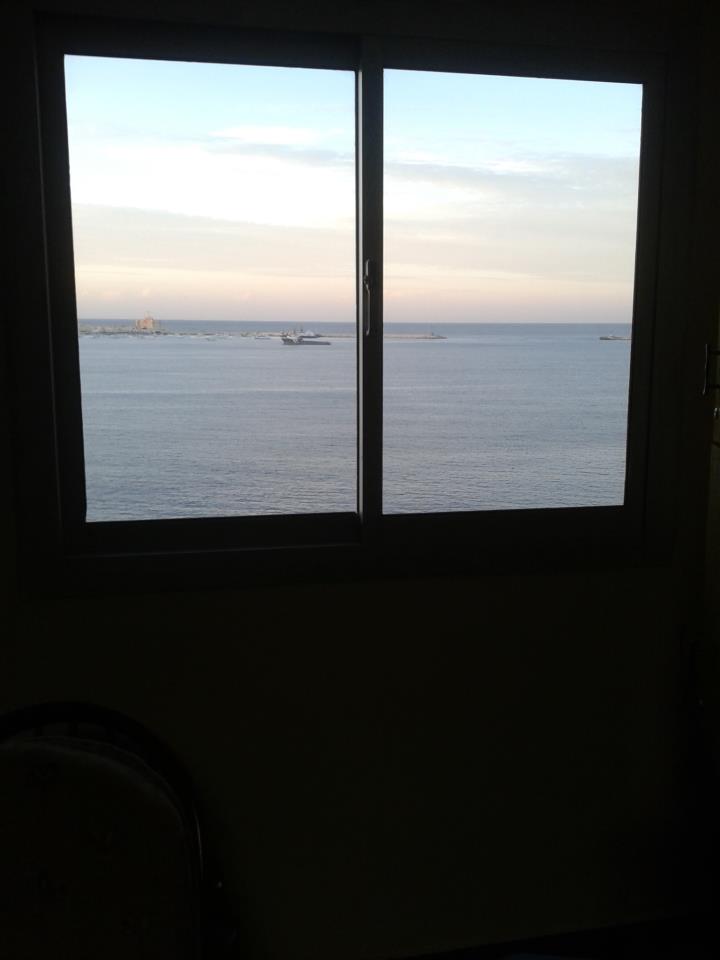
Above is a pic of the outside view from the window of where I'll be living.


Sunday, May 20, 2012

Spring in New York

I'd like to finish posting pics of my trip to the Amazon so I can (perhaps) utilize this site for additional purposes. Thus, another push with (hopefully) the last (almost) set of photos. Enjoy!


We hung our hammocks in and outside the Forest Family House.


Learning to make baskets out of Palm tree fibers we collected in the jungle.


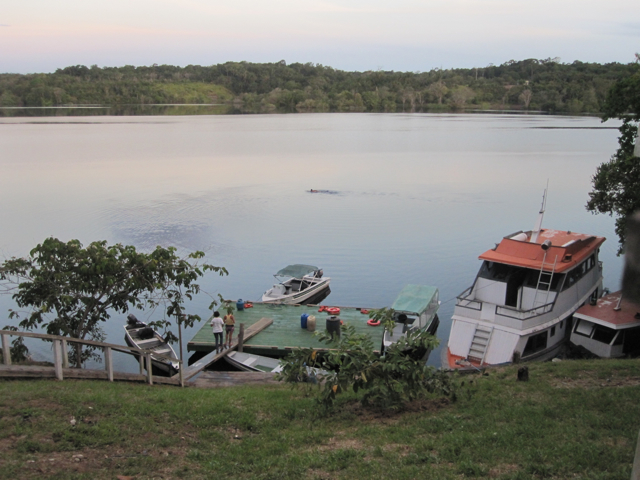
This is where the women washed clothes. We used this dock to "swim" from. I put that in quotations because we weren't really allowed to swim, it was considered too dangerous to go more than a few yards from the shore.


This was the main dock we got to jump in the water from. It's getting dark now.


The computer lab where I spent a lot of my time writing manuals for open source software on an open source operating system, in Portuguese, which I don't speak!